12 octopuses worth meeting
There are around 300 octopus species. Here are 12 of them, from the biggest to the deepest, the most dangerous and the most surprising.
There are roughly 300 species of octopus, and the number keeps changing as new species are discovered. Smithsonian Ocean: Octopuses, squids and relatives · checked 28 Oct 2026 At least eight species of octopus live in Alaskan waters. NOAA Fisheries: Octopus research in Alaska
- Monterey Bay Aquarium: a full-grown giant Pacific octopus can weigh more than 50 pounds (23 kg). The heaviest on record weighed 200 pounds (91 kg) and measured nearly 20 feet (6 m) across. Monterey Bay Aquarium: Giant Pacific octopus · checked 28 Oct 2026
- NOAA’s Kodiak lab: giant Pacific octopuses average 30–50 lbs and 6–8 feet long, and the largest recorded, caught in Alaska, weighed over 600 pounds. NOAA Fisheries: Inside the Kodiak Lab aquarium (giant Pacific octopus) · checked 28 Oct 2026
- Britannica: the giant Pacific octopus may grow to 5.4 metres (18 feet) long, with an arm span of almost 9 metres. Britannica: Octopus · checked 28 Oct 2026
A soft, stretchy animal is hard to weigh and measure, and old records are hard to check. These figures are far apart, so we show them all rather than pick one. Every disagreement we found →
- Britannica: the smallest octopus, Octopus arborescens, is about 5 cm (2 inches) long. Britannica: Octopus · checked 28 Oct 2026
- Smithsonian Ocean: the smallest cephalopods, like the California lilliput octopus, could sit on the tip of your finger. Smithsonian Ocean: Octopuses, squids and relatives · checked 28 Oct 2026
The two sources name different species, and only one gives a measurement. Every disagreement we found →
Sizes and records can change as new animals are measured; those facts carry the date we checked them (28 Oct 2026).
Blue-ringed octopuses are shy and usually dart for cover when they meet people. They only bite if picked up, and the bite may not even be felt. Australian Museum: Blue-lined octopus Fast mouth-to-mouth rescue breathing has saved more than 10 documented bite victims. If you suspect a bite, get medical help immediately. Australian Museum: Southern blue-lined octopus · checked 28 Oct 2026
Big and everyday
The largest octopus, the best-known one and a reef regular.
Small and venomous
Tiny, beautiful and best left alone.
Tricksters and builders
Impersonators, coconut carriers and city-dwellers.
The deep sea
Ear-fins, a ghost and the longest-brooding mother known.
The odd one
An octopus that grows its own shell.
No. 01 · Enteroctopus dofleini
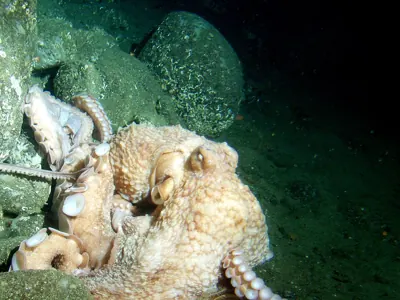
Giant Pacific octopus
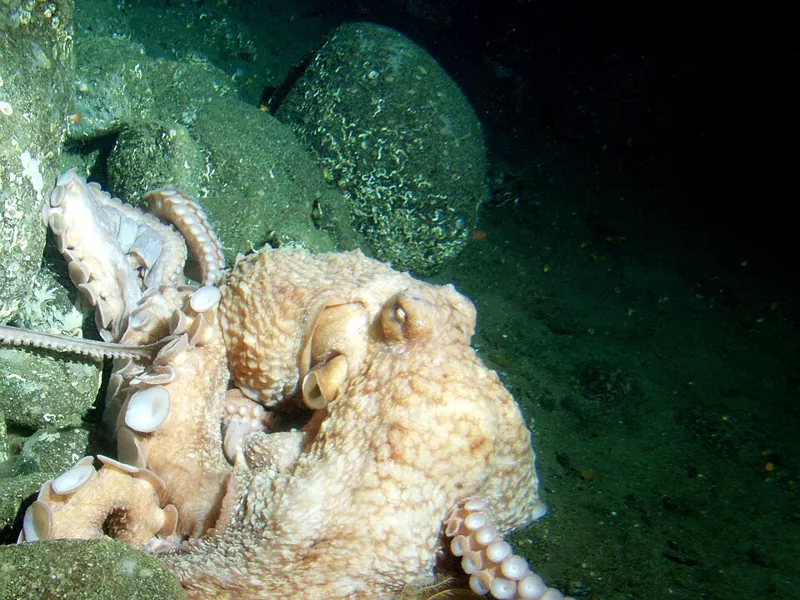
- The giant Pacific octopus is the largest octopus species. Monterey Bay Aquarium: Giant Pacific octopus
- The giant Pacific octopus lives in the North Pacific, from Korea and Japan to Canada, the US and Mexico, in water of 60°F (about 16°C) or colder, from tide pools to 1,500 m deep and more. Monterey Bay Aquarium: Giant Pacific octopus
- A female giant Pacific octopus has about 2,240 suckers; males have about 100 fewer. Monterey Bay Aquarium: Giant Pacific octopus
- The giant Pacific octopus hatches from an egg the size of a grain of rice. The hatchling weighs 22 milligrams. Monterey Bay Aquarium: Giant Pacific octopus
- Giant Pacific octopuses eat mostly crabs, clams and other molluscs. Monterey Bay Aquarium: Giant Pacific octopus
- Monterey Bay Aquarium: a full-grown giant Pacific octopus can weigh more than 50 pounds (23 kg). The heaviest on record weighed 200 pounds (91 kg) and measured nearly 20 feet (6 m) across. Monterey Bay Aquarium: Giant Pacific octopus · checked 28 Oct 2026
- NOAA’s Kodiak lab: giant Pacific octopuses average 30–50 lbs and 6–8 feet long, and the largest recorded, caught in Alaska, weighed over 600 pounds. NOAA Fisheries: Inside the Kodiak Lab aquarium (giant Pacific octopus) · checked 28 Oct 2026
- Britannica: the giant Pacific octopus may grow to 5.4 metres (18 feet) long, with an arm span of almost 9 metres. Britannica: Octopus · checked 28 Oct 2026
- Octopuses usually live no more than a year. The giant Pacific octopus is a long-lived exception, at about three to five years. Monterey Bay Aquarium: Giant Pacific octopus
- NOAA’s Kodiak lab says the giant Pacific octopus has the longest lifespan of any octopus species, 3 to 5 years. NOAA Fisheries: Inside the Kodiak Lab aquarium (giant Pacific octopus) · checked 28 Oct 2026
- A female giant Pacific octopus lays an average of 50,000 eggs, which helps make the species naturally resilient. Monterey Bay Aquarium: Giant Pacific octopus
- The Monterey Bay Aquarium says the giant Pacific octopus is not endangered. Monterey Bay Aquarium: Giant Pacific octopus · checked 28 Oct 2026
No. 02 · Octopus vulgaris
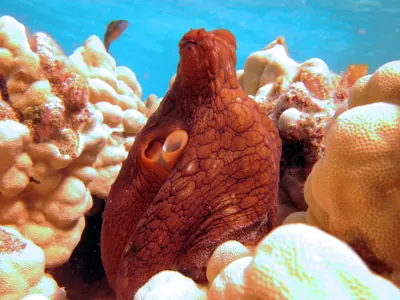
Common octopus
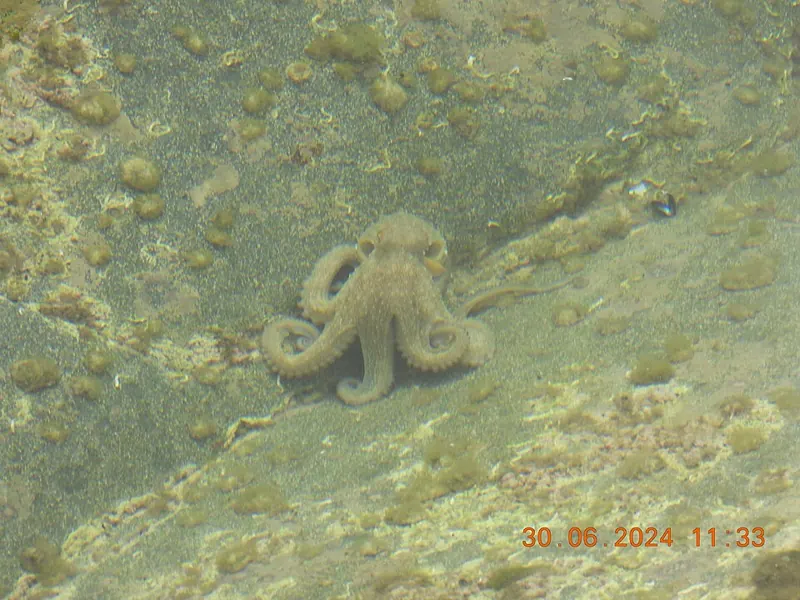
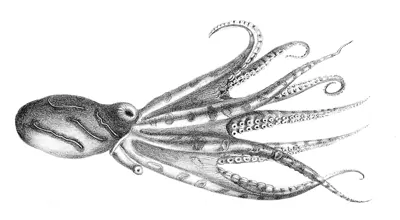
- The common octopus (Octopus vulgaris) is the best-known octopus. It lives in tropical and temperate seas worldwide, hides in holes and crevices on rocky bottoms and feeds mainly on crabs. Britannica: Octopus
- Britannica says the common octopus is thought to be the most intelligent of all invertebrates. Britannica: Octopus
- The common octopus has around 500 million neurons, about as many as a dog. About two thirds of them are in its arms. Natural History Museum, London: Octopuses keep surprising us
- In 1899 a Plymouth newspaper complained that common octopuses had become so abundant they had ‘quite ruined the fisheries’, eating crabs, lobsters and oysters. Smithsonian Ocean: Octopuses, squids and relatives
No. 03 · Octopus cyanea
Day octopus
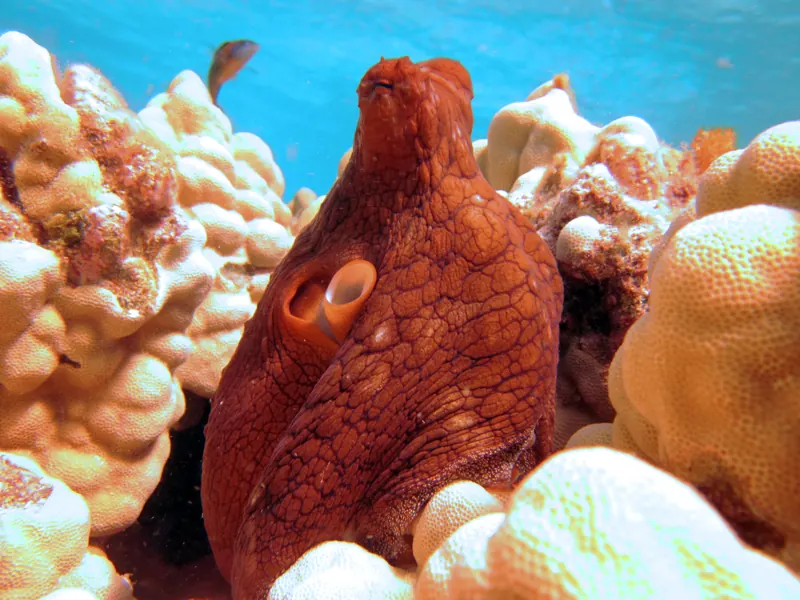
- The day octopus (Octopus cyanea) can shape itself like algae or coral to hide from predators or stalk prey. Smithsonian Ocean: Octopuses, squids and relatives
No. 04 · Hapalochlaena
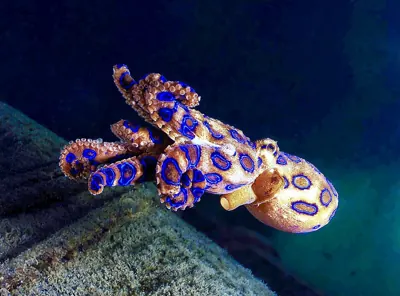
Blue-ringed octopuses
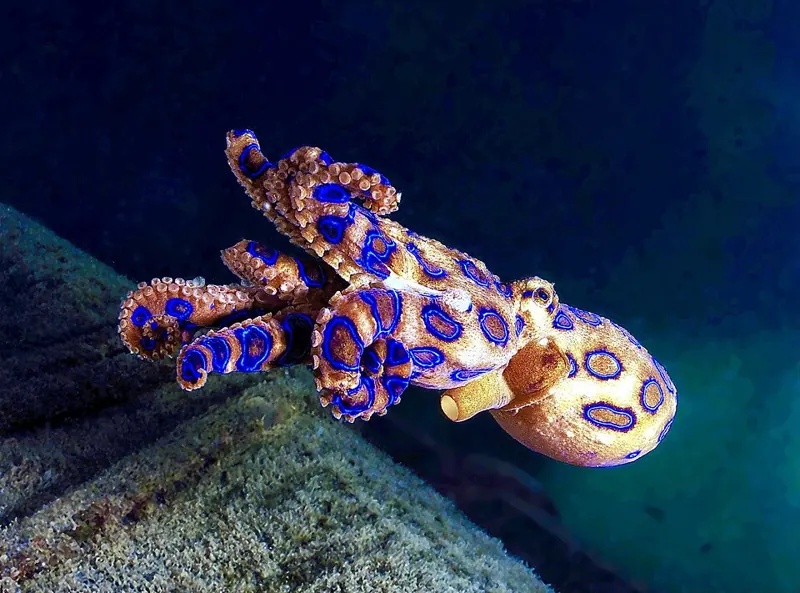
- The blue-ringed octopus isn’t one species but a whole genus, Hapalochlaena, all with glowing blue rings. Australian Institute of Marine Science: Blue-ringed octopus
- Blue-ringed octopuses are small: 4 to 6 cm long, with arms 7 to 10 cm long. Australian Institute of Marine Science: Blue-ringed octopus
- The blue rings usually only flash when the octopus feels threatened. Australian Institute of Marine Science: Blue-ringed octopus
- Its venom is tetrodotoxin, made by bacteria that live in its salivary glands. Australian Institute of Marine Science: Blue-ringed octopus
- Blue-ringed octopuses are shy and usually dart for cover when they meet people. They only bite if picked up, and the bite may not even be felt. Australian Museum: Blue-lined octopus
- Australian Museum (southern blue-lined octopus page): blue-ringed octopuses have caused at least three human deaths and many near-deaths. Australian Museum: Southern blue-lined octopus · checked 28 Oct 2026
- Australian Museum: there have been several deaths in Australia from the blue-lined octopus and its relatives. Australian Museum: Blue-lined octopus · checked 28 Oct 2026
- Victims can’t move or answer, but they stay fully conscious. Australian Museum: Southern blue-lined octopus
- Fast mouth-to-mouth rescue breathing has saved more than 10 documented bite victims. If you suspect a bite, get medical help immediately. Australian Museum: Southern blue-lined octopus · checked 28 Oct 2026
- Female blue-ringed octopuses care for their eggs until they hatch, and usually die once the job is done. Australian Institute of Marine Science: Blue-ringed octopus
No. 05 · Hapalochlaena fasciata
Blue-lined octopus
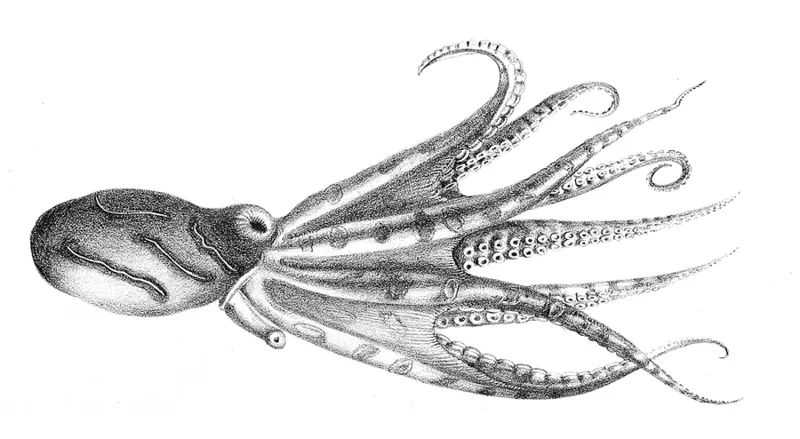
- Australian Museum: there have been several deaths in Australia from the blue-lined octopus and its relatives. Australian Museum: Blue-lined octopus · checked 28 Oct 2026
- Blue-ringed octopuses are shy and usually dart for cover when they meet people. They only bite if picked up, and the bite may not even be felt. Australian Museum: Blue-lined octopus
No. 06 · Thaumoctopus mimicus
Mimic octopus
We haven’t found a public domain or CC0 photo of this octopus that we can be sure is labelled correctly, so there’s no picture yet.
- The mimic octopus can impersonate a banded sole (a poisonous flatfish), a lionfish and a banded sea snake, changing its shape, texture and movement to match. American Museum of Natural History: The talented mimic octopus
- To play a sea snake, the mimic octopus hides six arms and stretches the other two out in opposite directions. American Museum of Natural History: The talented mimic octopus
- The mimic octopus was discovered in 1998. It was the first animal known to switch between impersonating several different animals. American Museum of Natural History: The talented mimic octopus · checked 28 Oct 2026
- The mimic octopus was discovered off Sulawesi, Indonesia. Most sightings come from Indonesia, though it has been seen as far away as the Great Barrier Reef. National Geographic: Mimic octopus
- The mimic octopus grows up to 24 inches (about 60 cm) long, arms included. National Geographic: Mimic octopus
- The mimic octopus has its own copycat: the harlequin jawfish hides among its arms, matching their stripes. American Museum of Natural History: The talented mimic octopus
No. 07 · Amphioctopus marginatus
Veined (coconut) octopus
We haven’t found a public domain or CC0 photo of this octopus that we can be sure is labelled correctly, so there’s no picture yet.
- Veined octopuses in Indonesia collect coconut-shell halves, stack them, carry them across the seafloor on stiffened arms and later hide inside: one of the first reports of tool use by an invertebrate. ScienceDaily, reporting Finn, Tregenza & Norman 2009, Current Biology
- A 2005 study found that the coconut octopus and the algae octopus can tiptoe backwards on just two arms. Smithsonian Ocean: Octopuses, squids and relatives
No. 08 · Octopus tetricus
Gloomy octopus
We haven’t found a public domain or CC0 photo of this octopus that we can be sure is labelled correctly, so there’s no picture yet.
- Most octopuses live alone, but gloomy octopuses gather in underwater ‘cities’ researchers nicknamed Octopolis and Octlantis. Smithsonian Ocean: Octopuses, squids and relatives
No. 09 · Grimpoteuthis
Dumbo octopuses
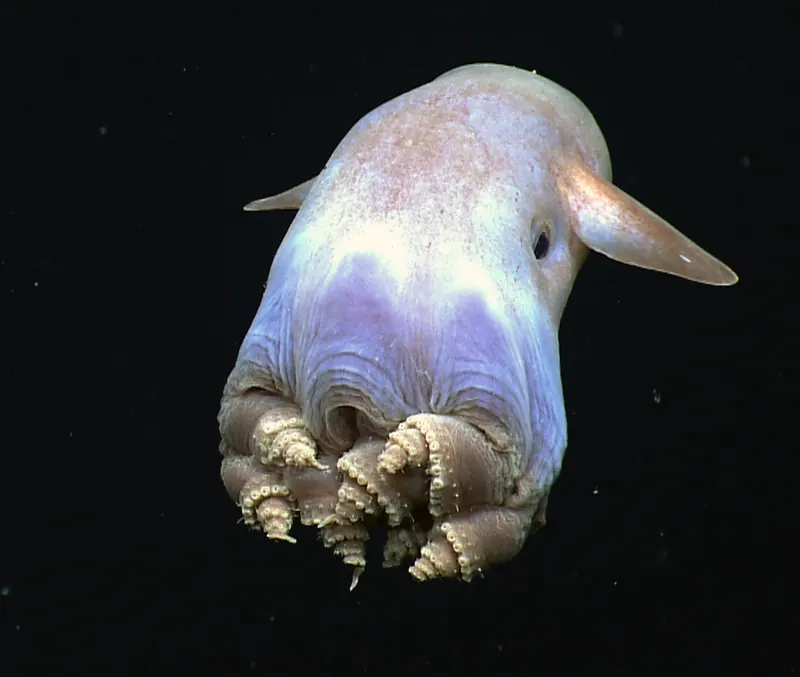
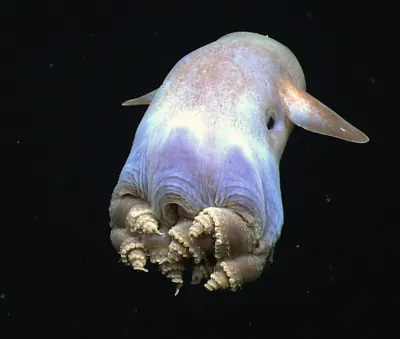
- Dumbo octopuses are deep-sea octopuses with two ear-like fins on the sides of the body, which they use to float and swim. Smithsonian Ocean: Octopuses, squids and relatives
- The dumbo octopus has no ink sac. In the permanent dark of the deep sea there is little point. NOAA Ocean Exploration: Cephalopods
- NOAA Ocean Exploration: the dumbo octopus is one of the deepest-living octopuses and has been found 4,000 metres deep. NOAA Ocean Exploration: Cephalopods · checked 28 Oct 2026
- In 2019, cameras filmed a dumbo octopus (Grimpoteuthis) 6,957 metres down in the Java Trench, Indian Ocean: the deepest cephalopod ever reliably seen. Jamieson & Vecchione 2020, Marine Biology (peer-reviewed) · checked 28 Oct 2026
- That sighting pushed the known depth limit for cephalopods down by 1,812 metres. Jamieson & Vecchione 2020, Marine Biology (peer-reviewed) · checked 28 Oct 2026
No. 10 · not yet named by scientists
‘Casper’ octopus
We haven’t found a public domain or CC0 photo of this octopus that we can be sure is labelled correctly, so there’s no picture yet.
- In 2016, scientists on NOAA’s Okeanos Explorer discovered a ghostly ‘Casper’ octopus about 4,000 metres down in the central Pacific. Smithsonian Ocean: Octopuses, squids and relatives · checked 28 Oct 2026
No. 11 · Graneledone boreopacifica
Deep-sea brooding octopus
We haven’t found a public domain or CC0 photo of this octopus that we can be sure is labelled correctly, so there’s no picture yet.
- A deep-sea octopus, Graneledone boreopacifica, brooded her eggs for 53 months (May 2007 to September 2011) at 1,397 m in Monterey Canyon: the longest egg-brooding period known for any animal. Robison et al. 2014, PLOS ONE (peer-reviewed) · checked 28 Oct 2026
- Scientists counted the empty egg capsules afterwards and estimate she was guarding between 155 and 165 eggs. Robison et al. 2014, PLOS ONE (peer-reviewed)
- In all that time the researchers never saw her leave her eggs or eat anything, not even small crabs and shrimp that wandered past. MBARI: Deep-sea octopus broods eggs for over four years
- The previous record for octopus brooding was 14 months, for Bathypolypus arcticus in the lab. Robison et al. 2014, PLOS ONE (peer-reviewed) · checked 28 Oct 2026
No. 12 · Argonauta
Argonaut (paper nautilus)
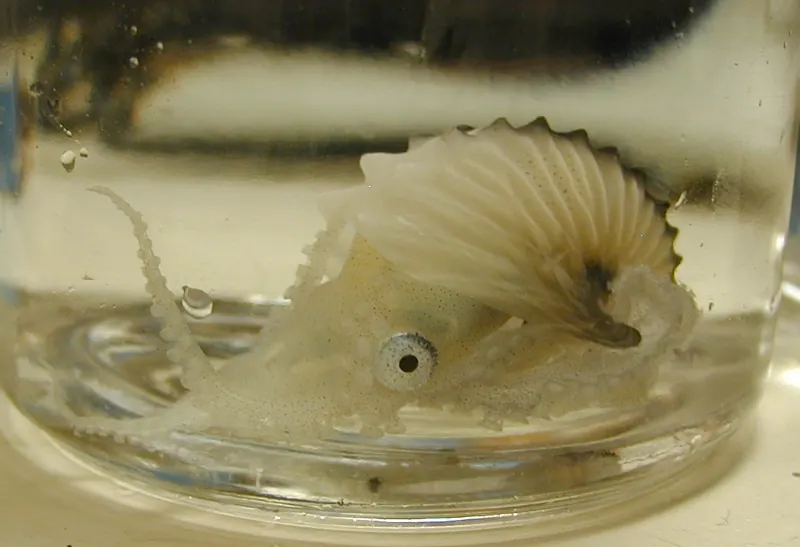
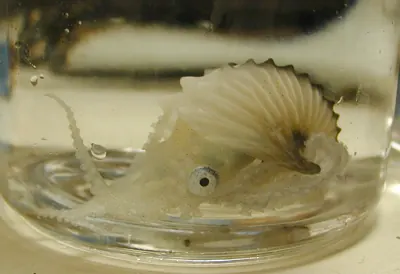
- The paper nautilus, or argonaut, is actually an octopus. The female makes a paper-thin, shell-like egg case. Smithsonian Ocean: Octopuses, squids and relatives
- The argonaut traps air in its papery case at the surface and dives until the squashed air bubble balances its weight. Smithsonian Ocean: Octopuses, squids and relatives