Three hearts and blue blood
No bones, eight arms, three hearts, copper in the blood and a brain shaped like a doughnut. Here’s how an octopus is put together.
Three hearts
Octopuses have three hearts. Two branchial hearts push used blood through the gills, and a systemic heart pumps the fresh, oxygen-rich blood around the body. Smithsonian Ocean: Octopuses, squids and relatives Like us, octopuses have a closed circulatory system: their blood travels round the body inside vessels. National Aquarium: Otherworldly octopuses
The heart that pumps blood round the body stops beating while an octopus swims, which is why octopuses prefer crawling: swimming exhausts them. Shedd Aquarium: Eight strange and wonderful facts about octopuses
Blue blood
Their blood really is blue. It carries oxygen with a copper-based molecule called hemocyanin, while our blood uses iron. Smithsonian Ocean: Octopuses, squids and relatives Copper-based hemocyanin carries oxygen better than our iron-based hemoglobin when the water is cold and low in oxygen. Shedd Aquarium: Eight strange and wonderful facts about octopuses
When an octopus’s blood loses its oxygen (when the animal dies, for example) it stops being blue and turns clear. Natural History Museum, London: Octopuses keep surprising us
Brains everywhere
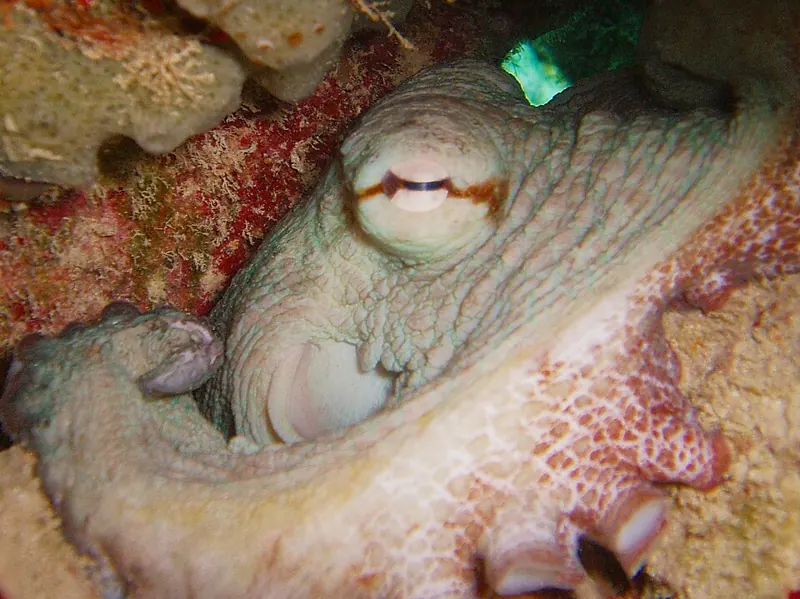
The common octopus has around 500 million neurons, about as many as a dog. About two thirds of them are in its arms. Natural History Museum, London: Octopuses keep surprising us The rest of the neurons are in a doughnut-shaped brain wrapped around the octopus’s oesophagus (food pipe). Natural History Museum, London: Octopuses keep surprising us
Each of an octopus’s eight arms has its own ‘mini brain’, and each arm can taste, touch and move without direction from the centre. Natural History Museum, London: Octopuses keep surprising us An octopus’s brain-to-body ratio is the largest of any invertebrate, and bigger than many vertebrates’ (though not mammals’). Natural History Museum, London: Octopuses keep surprising us
In a 2011 experiment, octopuses learned to steer a single arm through a maze to food, using their eyes: proof the central brain can take charge of an arm. Natural History Museum, London: Octopuses keep surprising us
- The rest of the neurons are in a doughnut-shaped brain wrapped around the octopus’s oesophagus (food pipe). Natural History Museum, London: Octopuses keep surprising us
- Each of an octopus’s eight arms has its own ‘mini brain’, and each arm can taste, touch and move without direction from the centre. Natural History Museum, London: Octopuses keep surprising us
- Counting the central brain and the eight arm ‘mini brains’, the Natural History Museum describes octopuses as having nine brains. Natural History Museum, London: Octopuses keep surprising us
One central brain, or nine? It depends whether you count each arm’s nerve centre as a brain. Every disagreement we found →
Arms that taste
An octopus’s arms carry more than 2,000 suckers, each able to move on its own. Shedd Aquarium: Eight strange and wonderful facts about octopuses The suckers have chemical sensors, so they don’t just feel: they taste and smell too. Shedd Aquarium: Eight strange and wonderful facts about octopuses
Harvard scientists found a family of ‘chemotactile receptors’ in the suckers that let octopuses taste by touch. The receptors are found only in cephalopods (Cell, 2020). Harvard Molecular & Cellular Biology: How the octopus ‘tastes’ by touch Each arm’s suckers work as the octopus version of both a tongue and hands. Harvard Molecular & Cellular Biology: How the octopus ‘tastes’ by touch
No bones, one beak
With no bones, an octopus can squeeze through any gap big enough for its beak, which is made of chitin. National Aquarium: Otherworldly octopuses Octopuses eat with a sharp beak. Inside it, a tongue-like radula lined with tiny teeth can push food down or drill holes in shells. Smithsonian Ocean: Octopuses, squids and relatives
The giant Pacific octopus’s shell has shrunk to two small plates where its head muscles anchor. Monterey Bay Aquarium: Giant Pacific octopus
Getting about
Octopuses can jet away by squirting water from the mantle through the funnel, but bottom-dwelling octopuses usually save jet propulsion for escapes and walk on their arms instead. Smithsonian Ocean: Octopuses, squids and relatives A 2005 study found that the coconut octopus and the algae octopus can tiptoe backwards on just two arms. Smithsonian Ocean: Octopuses, squids and relatives
A few shore-dwelling octopuses make short trips out of the water at low tide, but they can only last a few minutes before crawling back to the sea. Shedd Aquarium: Eight strange and wonderful facts about octopuses
Colour and texture
Colour changes come from thousands of pigment-filled cells called chromatophores. Muscles stretch each one open to show its red, brown or yellow pigment. Smithsonian Ocean: Octopuses, squids and relatives Octopuses change texture as well as colour, by raising bumps on their skin called papillae. Smithsonian Ocean: Octopuses, squids and relatives
Britannica reports that the giant Pacific octopus can change colour in a tenth of a second. Britannica: Octopus
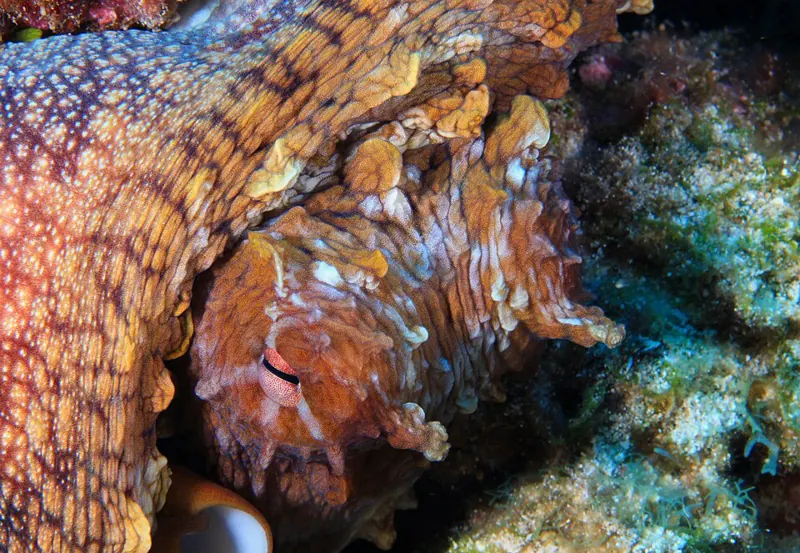
Cephalopods have only one type of light-receptor cell, so they are most likely colour-blind. But a recent study suggests their oddly shaped pupils might let some of them tell colours apart anyway. Nobody knows for sure yet. Smithsonian Ocean: Octopuses, squids and relatives
- Cephalopods have only one type of light-receptor cell, so they are most likely colour-blind. But a recent study suggests their oddly shaped pupils might let some of them tell colours apart anyway. Nobody knows for sure yet. Smithsonian Ocean: Octopuses, squids and relatives
Still an open question. Every disagreement we found →
Ink and venom
Almost all cephalopods have an ink sac that can release a sudden plume of dark ink, made from melanin and a thick mucus. Smithsonian Ocean: Octopuses, squids and relatives Octopus ink isn’t just a smokescreen. It contains tyrosinase, which irritates a predator’s eyes and scrambles its senses of smell and taste. Smithsonian Magazine: Ten wild facts about octopuses
All octopuses are venomous, but only the blue-ringed octopuses are dangerous to people. Shedd Aquarium: Eight strange and wonderful facts about octopuses In many cephalopods, not just the blue-ringed octopus, a salivary gland produces a paralysing venom. Smithsonian Ocean: Octopuses, squids and relatives
Next: smarts & escapes →