Eggs and mothers
Most octopuses breed once, guard their eggs and die soon after. One deep-sea mother holds the record for the longest egg-guarding of any animal known.
Once in a lifetime
For most cephalopods, mating is a once-in-a-lifetime event: both male and female die shortly afterwards. Smithsonian Ocean: Octopuses, squids and relatives Octopuses typically breed once and then die. In most shallow-water species the mother tends her eggs for 1 to 3 months. Robison et al. 2014, PLOS ONE (peer-reviewed)
The male uses a specially modified arm, the hectocotylus, to pass packets of sperm to the female. Britannica: Octopus A giant Pacific octopus lives alone until the very end of its life, when it seeks out a mate, reproduces and dies soon after. Monterey Bay Aquarium: Giant Pacific octopus
Guarding the eggs
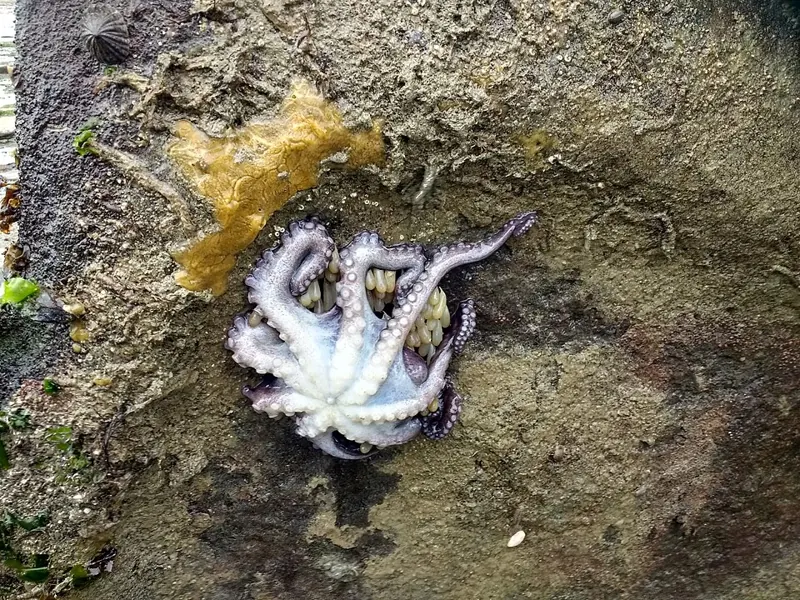
The mother stops eating and spends her time fanning the eggs with water to keep them clean and guarding them from predators. Smithsonian Ocean: Octopuses, squids and relatives A female giant Pacific octopus lays an average of 50,000 eggs, which helps make the species naturally resilient. Monterey Bay Aquarium: Giant Pacific octopus
Tiny hatchlings
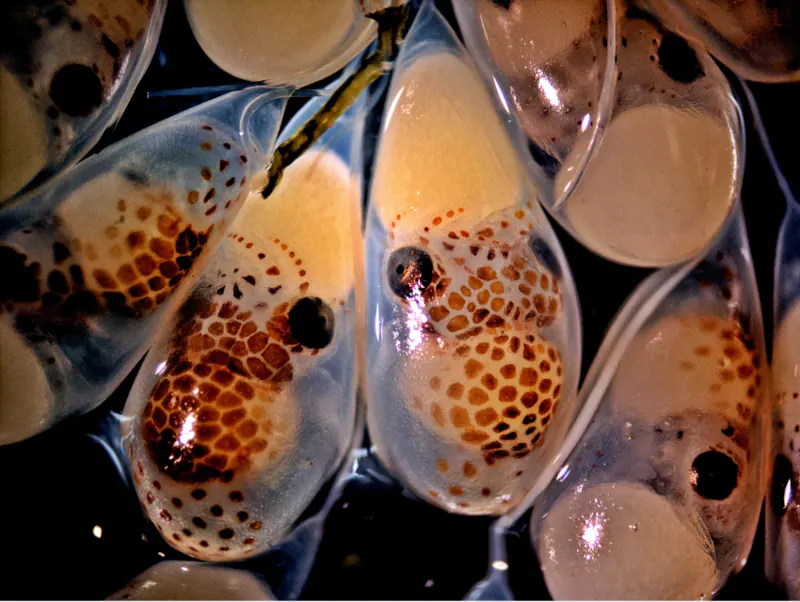
The giant Pacific octopus hatches from an egg the size of a grain of rice. The hatchling weighs 22 milligrams. Monterey Bay Aquarium: Giant Pacific octopus Giant Pacific octopus hatchlings are just over a quarter of an inch long, with about 14 suckers on each arm, and drift in surface waters eating plankton. Monterey Bay Aquarium: Giant Pacific octopus
The 53-month mother
A deep-sea octopus, Graneledone boreopacifica, brooded her eggs for 53 months (May 2007 to September 2011) at 1,397 m in Monterey Canyon: the longest egg-brooding period known for any animal. Robison et al. 2014, PLOS ONE (peer-reviewed) · checked 28 Oct 2026 MBARI researchers dived to the brooding mother 18 times over four and a half years, and found her in the same place every time, recognisable by her scars. MBARI: Deep-sea octopus broods eggs for over four years
In all that time the researchers never saw her leave her eggs or eat anything, not even small crabs and shrimp that wandered past. MBARI: Deep-sea octopus broods eggs for over four years Scientists counted the empty egg capsules afterwards and estimate she was guarding between 155 and 165 eggs. Robison et al. 2014, PLOS ONE (peer-reviewed)
The previous record for octopus brooding was 14 months, for Bathypolypus arcticus in the lab. Robison et al. 2014, PLOS ONE (peer-reviewed) · checked 28 Oct 2026 The very long development time is most likely a response to the cold of the deep sea. Smithsonian Ocean: Octopuses, squids and relatives
- NOAA’s Kodiak lab says the giant Pacific octopus has the longest lifespan of any octopus species, 3 to 5 years. NOAA Fisheries: Inside the Kodiak Lab aquarium (giant Pacific octopus) · checked 28 Oct 2026
- A deep-sea octopus, Graneledone boreopacifica, brooded her eggs for 53 months (May 2007 to September 2011) at 1,397 m in Monterey Canyon: the longest egg-brooding period known for any animal. Robison et al. 2014, PLOS ONE (peer-reviewed) · checked 28 Oct 2026
- The previous record for octopus brooding was 14 months, for Bathypolypus arcticus in the lab. Robison et al. 2014, PLOS ONE (peer-reviewed) · checked 28 Oct 2026
NOAA calls the giant Pacific octopus the longest-lived species, but the deep-sea mother spent 53 months brooding alone. How old she was in total, nobody knows: deep-sea octopus lifespans are a mystery. Every disagreement we found →
Blue-ringed mothers
Female blue-ringed octopuses care for their eggs until they hatch, and usually die once the job is done. Australian Institute of Marine Science: Blue-ringed octopus
Next: where octopuses live →